The Long Night: Working with Tawny Owls and Fox at Bourne

I’d been wanting to visit the Wildlife Photography Hides at Bourne for a long time, and this session was booked with one subject in mind, tawny owls.
They’ve been a long-standing frustration. I’ve spent years trying to photograph them with very little to show for it, so the opportunity to work from a controlled hide, in what has reportedly been a particularly strong year for owls, felt like the right moment to try something different.
As with any wildlife session, expectations were deliberately low. Experience always comes first, anything else is a bonus.

The Setup
The wired hide itself is one of the most complete setups I’ve come across. Everything is designed for long sessions, comfort, positioning, and access to subjects have all been carefully thought through.
Distances are well judged. I worked primarily with a 200–600mm lens, though in practice something around 300mm would be ideal for much of what unfolds. The use of interchangeable props, posts, rocks, fence sections, adds variety while still keeping a consistent structure to the images.
Lighting is fully controlled and pre-set. There’s no adjustment from the photographer’s side, which removes one variable but also forces you to work within defined constraints. Before dark, we were given guidance on camera setup, and once the light dropped, the transition to flash was immediate.
From Natural Light to Flash
The shift from natural light to artificial light wasn’t gradual, it was a clear transition.
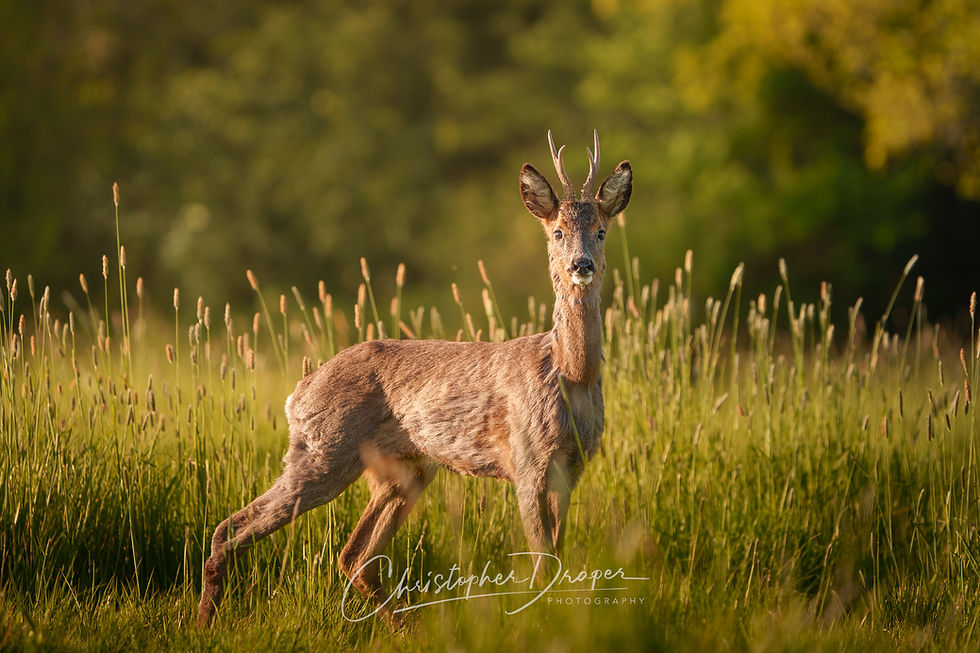
Up to sunset, everything behaves as expected. The roe buck that appeared early on was a welcome surprise, and a reminder that even in a managed environment, not everything is predictable.
Once the light went, the approach had to change completely. Under natural light, I’m typically balancing ISO against shutter speed. With flash, that relationship changes. Shutter speed is effectively capped by sync speed, in this case around 1/160, but the flash itself freezes the action. That took some adjustment in thinking, but the results were immediate. The level of sharpness, even in fast movement, was something I hadn’t experienced before.
The other constraint is rhythm. You’re no longer just responding to the subject, you’re also working around flash recycle times. Timing becomes more deliberate.
Working the Subjects
Fox
The foxes were steady but measured in their behaviour. They moved with purpose, coming in to feed, then gathering food to take away, presumably back to cubs.

They weren’t unpredictable, but they weren’t particularly slow either. There’s a balance between reacting and anticipating, and for the most part I found myself doing the former. The moments are there, but they don’t hang around.
Tawny Owl
The owls were the defining part of the night.

We lost count of how many visits we had, somewhere around twenty-five, but the experience changed as the session went on.
At first, it’s instinctive to shoot everything. There’s an urgency to it, especially given how difficult they are to encounter in normal conditions. But once a few frames are secured, that urgency settles. The focus shifts from capturing anything to trying to capture something specific.
As the night progressed, their behaviour became slightly more predictable. They began to use the perches more consistently, moving between them, which allowed for more deliberate positioning
and timing.

Even then, photographing them is not straightforward. The take-off is fast, a quick, decisive movement, and at 1/160 you effectively have one frame to get it right. It becomes about watching closely and committing at the right moment.
Compositional Approach
The structure of the hide dictates much of the composition.

Posts, rocks and fence lines become the only real anchors available, and those elements naturally define the frame. Rather than fighting that, it made sense to work with it, using those features to create consistency across the set.
In theory, I was aiming to shoot slightly wider to bring in more environment. In practice, that’s difficult once the light is gone. Without ambient light, the environment disappears, and the subject becomes the focus by default.
Throughout the session, the question was constant: how could this be better? Not just technically, but in terms of placement, timing, and clarity.
Editing the Work
The edit was not straightforward. From around 800 frames, there were very few outright misses. The combination of controlled conditions and flash meant that sharpness and focus were consistent across most of the images.
The challenge wasn’t quality, it was selection.
The final set was reduced to seven images, based on two criteria:
Does the image have presence?
Does it contribute something to the overall story?
Several images that worked well individually were removed because they repeated the same idea. Those will still be used elsewhere, but not within the core sequence.
Reflection
This session changed my perspective on flash photography. It’s easy to avoid it, or treat it as something separate from more naturalistic work, but used carefully it opens up opportunities that simply aren’t possible otherwise. It’s something I’ll be exploring further.

More broadly, it reinforces a shift I’ve been working towards, being more deliberate in how I shoot and how I edit. Not just aiming for individual images with impact, but building sets that hold together and tell a clearer story. That’s where the real value of the night sits.


Comments